On this page
Almost everyone who wants to blow glass starts by pricing a furnace. That is the wrong first move, and the people who make it usually still have not touched hot glass a year later. Hot glass is a team craft practised in a shared shop, and the cheapest route into it runs through someone else's equipment, not your own.
Start with a class, not with equipment
An intensive introductory class costs a fraction of a furnace and gives you something no amount of reading can: the feel of a pipe in your hands, the moment the gather stops behaving, and an honest sense of how much heat is involved. It also tells you whether you actually like the work, which is not a given.
After the class, the usual path is a local hot shop with open studio hours. You rent bench time, you use their furnace and their annealer, and you get to work alongside people who can tell you what you are doing wrong while it is still happening. That is worth far more than a furnace in a garage.
What a home studio actually needs
If you are working at home with a torch rather than a furnace — lampworking rather than off-hand blowing — the equipment list is smaller and the ventilation requirement is not. Torch work is where most home studios start, and it is where the safety planning has to be most careful, because the workspace is usually a room in a house.
| Item | Why it is on the list | Can it wait? |
|---|---|---|
| Torch | The heat source. A surface-mix or premix torch running on compressed oxygen and propane covers most clear and colour work. | No |
| Oxygen and propane | Compressed oxygen, not ambient air, for borosilicate. Suppliers differ on whether they deliver to residential addresses. | No |
| Regulators and hoses | You cannot run a torch off an unregulated tank. Hoses must be rated for the gas. | No |
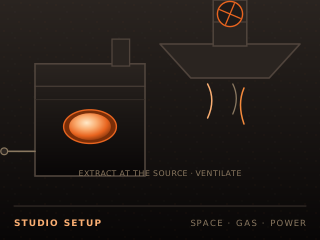
| Exhaust and make-up air | Combustion products and metal fume have to leave the room, and replacement air has to come in. | No |
| Safety glasses | Side shields, and a tint appropriate to the work. Sodium flare from soda-lime glass needs didymium or equivalent. | No |
| Graphite slab and hand tools | Where the hot glass goes and what shapes it. Graphite does not stick. | No |
| Clear rods and tubing | Consumables. Buy clear in bulk before you buy colour. | No |
| Annealer | Even small pieces need to be annealed. A small kiln is the honest minimum. | No |
| Colour | Expensive, and wasted on a beginner. Clear teaches more per pound. | Yes |
| A second torch | You will want one eventually. Learn the first one completely first. | Yes |
Learn on clear glass
Clear glass is the cheapest material in the shop and the most instructive. Every flaw shows: an uneven wall, a bubble you did not intend, a shape that is not quite round. Colour hides all of it. Beginners who start on colour spend their first year learning nothing and their second year unlearning it.
Budget for a lot of clear. The first fifty pieces you make will be bad, and that is the expected outcome, not a sign that you are doing it wrong.
What your first pieces should be
Choose forms that are short, solid or thick-walled, and forgiving of a pause. Thin, tall, or hollow pieces demand timing you do not have yet.
A solid paperweight or marble
One gather, one shape, straight into the annealer. It teaches gathering, marvering and getting the piece off the pipe without dropping it. Nothing else.
A small tumbler
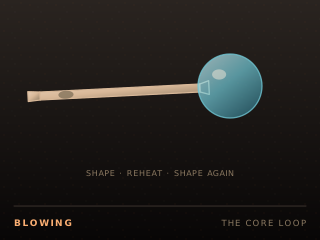
Your first hollow form. It teaches blowing a bubble, opening the top and keeping a wall even — the three skills everything else builds on.
A small bowl
Same skills as the tumbler with a different balance and a wider rim. Good practice for centrifugal work.
A bud vase
A narrow neck is where you learn that glass moves when you are not watching it. Expect the first few to slump.
Something with colour
Only once clear pieces are consistently even. Colour is a reward for competence, not a substitute for it.
The mistakes that cost beginners the most
- Buying equipment before taking a class. The money is better spent on bench time at a shop that already has everything.
- Working cold glass. Below roughly 800 °C glass does not move, it breaks. Reheat at the glory hole far more often than feels necessary.
- Trying to work alone. An assistant is not a luxury on anything larger than a tumbler.
- Skipping the annealer. An unannealed piece can look perfect and shatter a week later, and there is no way to tell by looking.
- Buying colour first. It hides every mistake you are trying to learn from.
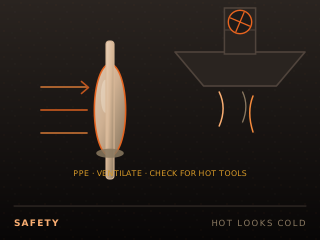
- Treating gloves as protection. Most glassblowers rarely wear them, because you cannot feel the glass through a glove — see the safety guide.
A realistic first-year budget
If you take the class-plus-hot-shop route, the largest line item is bench time, and the second is clear glass. Hand tools accumulate slowly and mostly second-hand. If you go the torch route at home, the torch and the ventilation dominate, and the ventilation is the part people under-budget.
Either way, do not spend on a furnace until you have spent a year in someone else's shop. The furnace is the last purchase, not the first.
“Get the intensive class under your belt and find a local hot shop to continue the journey. Hot glass is a team effort — you will need an assistant to complete anything.”