On this page
A glass furnace is a crucible held at a temperature for a very long time. Everything else — the burners, the insulation, the controls — exists to keep that one sentence true. Understanding a furnace means understanding what the melt is doing while nobody is watching it, because that is where nearly every furnace problem starts.
The three temperatures that matter
A furnace is not one temperature. It is at least three, and confusing them is the root of most beginner frustration.
| Temperature | What it means | Typical |
|---|---|---|
| Melting | Hot enough for the batch to become a liquid and for the fining agents to release the bubbles they were added to collect. | 1400-1450 °C |
| Working | The range where the glass can be gathered, blown and shaped. Below the bottom of this range it stops moving and starts cracking. | 1000-1200 °C |
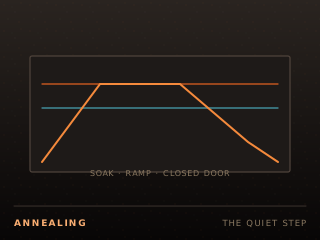
| Annealing | Where internal stress relaxes. This is a separate kiln entirely, and it is far cooler than the furnace. | 440-565 °C |
The furnace sits at melting temperature overnight and is usually lowered to working temperature for the day. The difference between those two is not a detail: glass held too hot for too long will boil, and a boiling melt traps bubbles that never come out.
The crucible is the part that fails
The crucible holds the melt. It is also the part of a furnace that wears out, and the way it is treated decides whether it lasts two months or two years.
- Thermal shock is what kills a crucible. A cold crucible filled with hot glass, or a hot crucible hit with a cold gather, will crack — and a cracked crucible means the whole melt is lost.
- The first melt should be a throwaway. A new crucible is glazed and conditioned by the first batch, and that batch is usually discarded rather than worked.
- Never let a crucible run dry and then refill it cold. Top up while the melt is still liquid.
- Metal tools and glass batch do not mix. A stray piece of steel in the melt becomes a stone in every gather for the rest of the crucible is life.
Daily maintenance is mostly observation
A furnace does not need much intervention. It needs someone to look at it, every day, in the same way, so that a change is obvious.
Check the melt surface before the first gather
A clean, bright, bubble-free surface means the melt is healthy. Scum, foam or a dull film means it has been held too hot or contaminated, and the top layer has to be skimmed.
Check the crucible is level and seated
A crucible that has shifted lets glass creep between it and the furnace floor, where it sets and eventually cracks the crucible.
Check the burner and the flame
A yellow, lazy flame is a reducing flame. It deposits carbon on the glass and turns colours muddy. Adjust for neutral or oxidising.
Check the controls against a known reading
Thermocouples drift. A furnace that has been reading two hundred degrees cool for a month has been running wrong for a month, and the glass will tell you before the controller does.
Top up before the level drops
A crucible that is allowed to empty and then refilled cold will crack. Keep it at least a third full at all times.
Log it
One line a day. Temperature, level, flame colour, anything odd. A furnace that fails on a Tuesday is much easier to diagnose if you know it started running rich three weeks earlier.
Gas, electric and the trade-off between them
Gas furnaces are cheaper to run and cheaper to repair, and they need a flue, make-up air and a combustion gas plan. Electric furnaces are cleaner, quieter, easier to control precisely and far more expensive to run at melting temperature, which is why many studios run electric for small day tanks and gas for the main melt.
For a small studio, the practical question is not which is better but which you can power, vent and afford to run continuously. A furnace is not switched off at the end of the day. Whatever you choose has to be economical at 24 hours a day.
What goes wrong, and what it looks like
| Symptom | Usual cause | What to do |
|---|---|---|
| Bubbles through the whole melt | Over-heated and boiling, or contaminated batch | Lower the setpoint, skim the surface, check the batch for moisture |
| Stones or cords in the gather | Undissolved batch, or refractory falling into the melt | Check the batch mix and the furnace roof; skim and discard the affected layers |
| Colour going muddy and grey | Reducing flame depositing carbon | Adjust to a neutral or oxidising flame and reheat the piece to burn the carbon off |
| A crack up the crucible wall | Thermal shock from a cold gather or a cold refill | Stop work. A cracked crucible is a full melt loss, not something to work around |
| Furnace cannot hold temperature | Failed thermocouple, failing element, or insulation breakdown | Verify with a second reading before replacing anything |