On this page
There are only a handful of hand tools in a hot shop, and each of them does one job well. The trouble is that they all look like they could do each other is jobs, and beginners reach for the wrong one constantly. Here is what each tool is actually for, and what it does when you use it wrong.
Jacks: the tool you will use most
Jacks are a pair of curved blades that close around the glass and squeeze it. They are the primary shaping tool, and they do three things: they narrow a neck, they smooth a surface, and they true up a profile.
- The blades are curved so that closing them around a rotating gather produces a round shape rather than a flat one.
- They must be wet. Jacks are dipped in water before every use, and shaken dry so they are damp rather than dripping.
- They must be warm. Cold steel on hot glass produces a chill mark — a small check in the surface that will become a crack during annealing.
- They work best on a piece that is hot. Jacking cold glass does not shape it, it chips it.
Pliers and tweezers: pulling and placing
Pliers grip and pull. They are used to draw out a stem, pull a lip, or hold a piece while something else is done to it. Tweezers are the fine version, for picking up a small hot bit and placing it precisely.
Both are used on glass that is hot and moving. Pulling on cold glass tears the surface, and the tear is a permanent scar — it will not close when you reheat, and it will not grind out of a curved surface without changing the shape.
Paddles: flattening and squaring
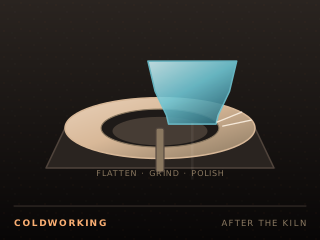
A paddle is a flat plate, usually graphite or soaked wood, used to flatten a surface or square a base. It removes heat as it presses, which is why it works: the surface stiffens under the paddle and holds the shape.
- Wooden paddles must be soaked. A dry wooden paddle will burn and leave char marks in the glass.
- Graphite paddles need no soaking and do not stick, which makes them the better choice for a base that has to be genuinely flat.
- Paddle early. A base squared while the piece is hot and thick will stay square. One squared after the piece has stiffened will move again in the annealer.
- Paddle one face at a time, and let the piece rotate between presses. Pressing repeatedly in one spot flattens the rotation as well as the surface.
Shears: cutting hot glass
Hot shears cut glass like heavy scissors, and they are used to trim a rim, cut a neck, or take a piece off the pipe. They are the one hand tool that removes material rather than moving it, which matters: everything else in this article conserves the glass volume, and shears do not.
Shears have to be hot. A cold shear blade on hot glass produces a chill mark along the cut line, and a cut line is exactly where a crack wants to start. Warm them in the glory hole before the first cut.
The order to use them in
Tools are not interchangeable, and the sequence is not arbitrary. Working in the wrong order means redoing the shape you just set.
Reheat
Nothing below roughly 800 °C can be shaped. If the glass resists the tool, the answer is the glory hole, not more force.
Set the neck with jacks
The neck is the narrowest part and it decides where the piece balances. Do it first, while the whole gather is hot.
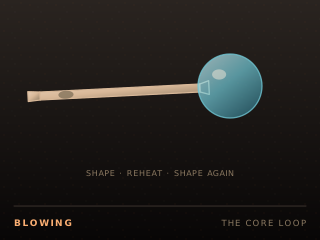
Open the form by blowing
Blowing after the neck is set keeps the neck where you put it. Blowing first and then jacking a neck moves glass out of the form.
Flatten or square with a paddle
Paddle the base or the faces while the piece is still thick enough to hold the shape it is given.
Draw out details with pliers
Pulling a stem or a lip is the last hot step, because it thins the glass and thinned glass cools fastest.
Trim with shears
Cut the rim or take the piece off last, and only with hot shears.
Straight into the annealer
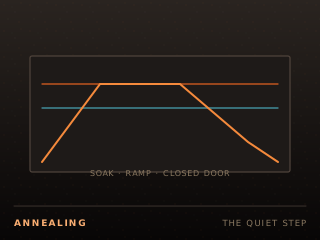
Every tool pass leaves stress. The annealer is what removes it, and the clock on the piece starts the moment it stops moving.
The five mistakes that show up on the finished piece
| What you see | What caused it | How to avoid it |
|---|---|---|
| Small checks or cracks around a neck | Wet or cold jacks applied to hot glass | Shake the water off, warm the blades, and reheat the neck after jacking |
| A torn, scarred surface | Steel tools applied to glass that had gone stiff | Reheat before the pass; a tear never closes |
| An off-centre neck | The pipe stopped turning during the jacking pass | Keep the pipe turning through the whole pass, not just between passes |
| A base that will not sit flat | The base was paddled after the glass had stiffened | Square the base while it is hot and thick |
| Char marks in the glass | A dry wooden paddle or block | Soak wooden tooling thoroughly before use |
“Most glassblowers don't wear gloves — you need to feel what's happening in the glass.”
That is not a style preference. Tool pressure, centring and temperature are all read through the hands, and a glove removes the information without removing the hazard — a glove that gets too hot can melt and cling to skin.