On this page
Colour on hot glass is applied in four ways: as frit, as powder, as oxide wash, and as leaf. Each produces a different surface and each fails differently. Underneath all four is one number — the coefficient of expansion — that decides whether the piece survives the annealer.
The coefficient of expansion is the whole game
Glass expands when it is heated and contracts when it cools. The coefficient of expansion, or COE, is how much. If two glasses with different COE values are fused together, they contract by different amounts as they cool, and the joint is under permanent stress from the moment the piece leaves the kiln.
| Glass family | Nominal COE | Notes |
|---|---|---|
| Soda-lime | Around 90 | The common furnace glass. Colour is supplied matched to it. |
| Borosilicate | Around 33 | Torch-working glass. Will not mix with soda-lime under any circumstances. |
| Lead crystal | Around 92 | Softer, denser, brighter. Anneals at a lower temperature. |
| Fused quartz | Around 5 | Extreme thermal shock resistance, extreme working temperature. |
| Aluminosilicate | Around 45 | High-temperature work. Narrow working range. |
A difference of one or two points is usually tolerable. A difference of ten will crack, and no amount of careful annealing will save it — the stress is built into the material, not introduced by the cooling.
Frit: chunky, opaque, immediate
Frit is crushed glass, graded by grain size. It is rolled onto a hot gather, where it sticks and melts into the surface. The result is a mottled, saturated colour with visible grain, and the grain size determines how much of the pattern survives.
- Coarse frit gives distinct, readable spots. Fine frit gives a near-solid wash.
- Frit must go onto a hot gather, or it will not stick and will simply fall off.
- More than a thin single layer will stiffen the piece noticeably — a heavily fritted gather moves like a much cooler one.
- Roll the gather in frit once and reheat. Rolling repeatedly builds up a load the piece cannot carry.
- Frit sitting on the surface of a thin bubble is a stress concentrator. It is safest on solid or thick-walled work.
Powder: soft, even, and easy to overdo
Powder is the same glass ground far finer, applied by sieving or rolling, and it produces a soft, even colour with no visible grain. It is the easiest way to get a clean, uniform tint and the easiest way to get a muddy one.
Because powder is so fine, a small amount goes a very long way. It also becomes airborne easily, which makes it a respiratory hazard as well as an aesthetic one — see the safety guide for the ventilation requirements.
Oxide wash: colour from a metal salt
Metal oxides are what colour glass in the first place: cobalt for blue, manganese for purple, iron for green and amber, copper for red and turquoise, chromium for green, gold for ruby. Applied as a wash to the surface of hot glass, they produce a thin, translucent colour that follows the shape of the piece.
Oxides behave differently from frit and powder because they are not glass. They dissolve into the surface layer, and the result depends on the flame chemistry as much as on the quantity applied.
| Oxide | Usual colour | Behaviour |
|---|---|---|
| Cobalt | Deep blue | Very strong. A trace is enough; too much goes black. |
| Manganese | Purple | Fades in a strongly oxidising flame. |
| Iron | Green to amber | The colour depends on the flame chemistry more than on the quantity. |
| Copper | Red or turquoise | Oxidising flame gives turquoise; reducing gives a dull red. |
| Chromium | Green | Strong, and can produce a chrome-oxide skin that separates. |
| Gold | Ruby | Very small quantities. Extremely expensive. |
Gold leaf: the expensive one
Gold leaf is applied to hot glass, where it fuses into the surface and produces a bright, metallic effect that no oxide reproduces. It is used sparingly, usually as accent lines or spots, because it is expensive and because a heavy application creates a stress mismatch of its own.
Leaf must go onto glass that is hot enough to fuse it but not so hot that it burns off. The window is narrow, and it is a technique worth practising on scrap before it goes on a finished piece.
Marble swirl: mixing colours on the gather
Swirling is the technique of applying two or more colours and then twisting them together with a tool or by rotating the pipe, producing a marble pattern. It is not a separate material — it is a way of using frit or powder.
The constraint is the same as everything else in this article: every colour in the swirl has to share a COE. A swirl of three matched colours is one of the most durable decorative techniques. A swirl of three unmatched ones is a piece that will crack along the boundary between them.
Getting it to survive the kiln
Check every COE before the colour goes on
Match to the base glass, and match to each other. If a colour is not labelled, do not put it on a piece you care about.
Apply less than you think
Colour stiffens the glass and concentrates stress. A thin application of a matched colour is more durable than a thick one.
Keep the flame neutral or oxidising
A reducing flame deposits carbon and muddies every colour on the piece.
Reheat evenly
A colour applied to one side of a gather creates a thermal gradient, and a thermal gradient is stress.
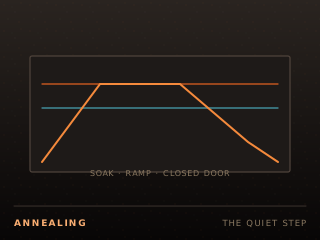
Anneal for the thickest section, not the average
Colour applied to the outside makes the effective wall thicker than the clear glass alone.
Expect the first few to crack
Colour is where the variables multiply. Work on clear until the COE habit is automatic.