COLOR & SURFACE
Colored Frit
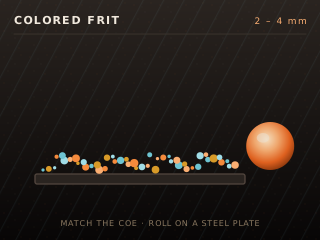
Crushed coloured glass, sieved to a grade, rolled onto a hot gather.
Specifications
- Particle grades
- Coarse 2 – 4 mm, medium 0.5 – 2 mm, fine under 0.5 mm
- Coefficient of expansion
- Must match the base glass — 90 for soda-lime, 33 for borosilicate
- Working temperature
- Fuses at 800 – 1000 °C depending on grade
- Coverage
- Roughly 5 – 25 g per 100 g of gather for a solid colour
- Storage
- Sealed and dry, sorted by grade and colour
- Base glass
- Usually the same family as the gather
- Availability
- Wide range of colours; some are leaded and some are not
Technical parameters
- Grade choice
- Coarse for bold speckle, fine for an even wash
- COE matching
- Non-negotiable. A mismatch shows up as a crack, not a colour
- Application
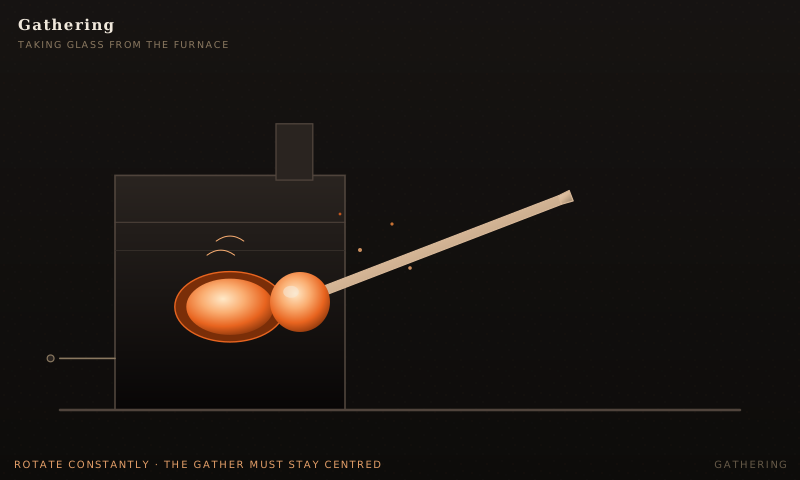
- Roll the hot gather over a tray of frit on a steel plate
- Fusing
- Reheat and marver after applying so the frit melts flush
- Layering
- Frit over clear, then more clear, buries the colour inside the wall
- Cost band
- Low to medium
Overview
Frit is coloured glass that has been crushed and sieved into a range of particle sizes. A hot gather is rolled in frit, the frit fuses into the surface, and the result is a speckled or solid colour depending on the grade and how much you use. Frit is the most direct way to add colour, and the most common way beginners ruin a piece — because the frit must match the base glass in coefficient of expansion, or the piece cracks during annealing.
Where it fits in the process
Colored Frit is used in color, gather. The stage decides how hot the glass has to be when the tool touches it, which in turn decides how much of the work it can do in one pass.
Safe use
- Frit dust contains respirable silica and metal oxides. Wear a P100 respirator when sieving or pouring it.
- Leaded frits and some oxide colours are toxic by ingestion and inhalation. Wash hands before eating.
- A frit-covered gather spits when it enters the glory hole. Keep your face back.
- Store frit sealed. A tray left open on the bench collects glass dust from everything else in the room.
How it is used
- Match the frit COE to the base glass before you buy it. Ask for the number, not the colour name.
- Roll the gather on a steel plate, not in the tray. It keeps the tray clean and the coverage even.
- Reheat and marver after applying so the frit fuses flush with the surface.
- For a solid colour, apply in two or three passes with a reheat between rather than one heavy roll.
- Bury the colour under a layer of clear if you want depth rather than surface texture.
Compatible glass types
Matching the tool to the glass family matters less than matching the glass to itself — see the COE compatibility calculator before combining two glasses.