COLOR & SURFACE
Metal Oxide
The raw oxide that gives glass its colour, and the chemistry behind it.
Specifications
- Typical colourants
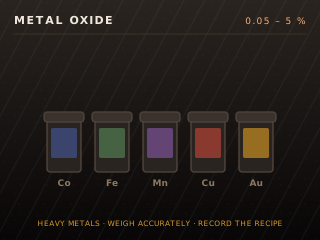
- Cobalt, iron, manganese, copper, chromium, nickel, gold, selenium
- Addition rate
- Typically 0.05 – 5 % by weight of the batch
- Cobalt
- The strongest colorant — 0.1 % gives a deep blue
- Iron
- Green in an oxidising melt, amber in a reducing one
- Copper
- Blue in an oxidising melt, red in a reducing one
- Gold
- The only practical route to a true ruby; very expensive
- Form
- Powder, usually 99 %+ purity
Technical parameters
- Oxidising atmosphere
- More oxygen in the flame; keeps iron green and copper blue
- Reducing atmosphere
- Less oxygen; drives iron to amber and copper to red
- Fining agents
- Antimony or arsenic compounds clear bubbles from the melt
- Batch calculation
- Colourant is added as a percentage of the sand, not the total batch
- Toxicity
- Almost every colorant is a heavy metal. All are hazardous
- Cost band
- Low for iron and manganese, extreme for gold
Overview
Every colour in glass comes from a metal oxide dissolved into the melt or fused onto its surface. Cobalt gives blue, iron gives green or amber depending on the furnace atmosphere, manganese gives purple, copper gives red or blue depending on oxidation state, and gold gives the deep ruby that costs more than the rest combined. Understanding oxides means understanding that colour is a chemical state, not a pigment — which is why the same oxide can give two different colours in two different furnaces.
Where it fits in the process
Metal Oxide is used in color. The stage decides how hot the glass has to be when the tool touches it, which in turn decides how much of the work it can do in one pass.
Safe use
- Metal oxide powders are heavy-metal compounds. Cobalt, chromium, nickel and lead are all toxic and some are carcinogenic.
- A P100 respirator, gloves and eye protection are required when weighing oxides. Do not work in a shared kitchen.
- Furnace fumes from colored melts carry metal vapours. Extract at the source and do not breathe the plume.
- Dispose of oxide waste as hazardous chemical waste. Never wash it down a drain.
How it is used
- Weigh colourants accurately — cobalt at 0.1 % and cobalt at 1 % are different glasses entirely.
- Control the furnace atmosphere deliberately. The same recipe gives green or amber depending on the flame.
- Add colourant to the batch as a percentage of the sand weight, and record it.
- Keep a written recipe for every colour you mix. Reproducing a colour from memory does not work.
- Test a new colour on a small gather before committing a full crucible.
Compatible glass types
Matching the tool to the glass family matters less than matching the glass to itself — see the COE compatibility calculator before combining two glasses.