COLOR & SURFACE
Glass Powder
Finely milled colour for a soft, even wash over the surface.
Specifications
- Particle size
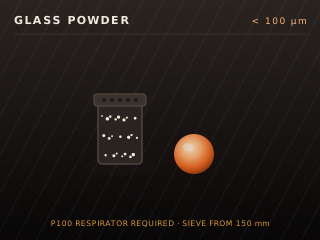
- Typically under 0.1 mm (100 µm)
- Coefficient of expansion
- Matched to the base glass, as with frit
- Fusing temperature
- Melts at 750 – 900 °C — lower than coarse frit
- Coverage
- 2 – 10 g per 100 g of gather for a soft wash
- Sieving
- 80 – 200 mesh for an even dusting
- Storage
- Sealed, dry, and labelled by colour and COE
- Hazards
- Very fine dust; the most respirable form of glass in the studio
Technical parameters
- Mesh size
- Finer mesh gives a softer tone; coarser gives visible grain
- Application
- A salt shaker or a fine sieve gives the most even coat
- Fusing
- Almost instantaneous at working temperature
- Layering
- Powder over powder builds tone without texture
- Masking
- Tape or a stencil can hold a clean line on a flat surface
- Cost band
- Medium
Overview
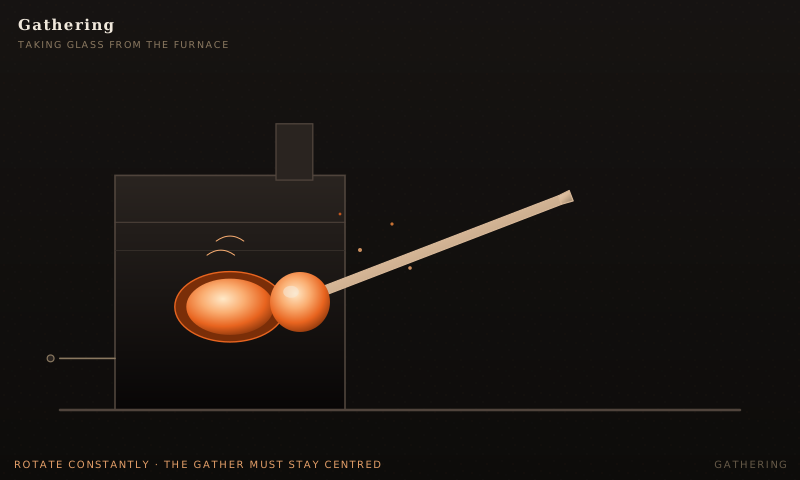
Glass powder is frit taken to its finest grade — milled to a flour-like consistency, typically under 0.1 mm. It is applied by sieving or sprinkling over a hot gather, where it melts almost instantly and gives a soft, even colour with no visible speckle. Because it fuses so readily, powder is the easiest way to get an even tone, and because it is so fine it is also the easiest way to get a lung full of glass dust.
Where it fits in the process
Glass Powder is used in color. The stage decides how hot the glass has to be when the tool touches it, which in turn decides how much of the work it can do in one pass.
Safe use
- Powdered glass is the most respirable glass material in the studio. A fitted P100 respirator is required, not suggested.
- Never dry-sieve powder in a room without extraction. The cloud hangs in the air for a long time.
- Some colours are formulated with lead or cobalt. Treat all powder as toxic and wash up after handling.
- Keep the powder away from the furnace air intake, or you will blow it across the studio.
How it is used
- Wear a P100 and work with extraction running. This is the material that does the most damage.
- Sieve from a height of about 150 mm for an even coat, moving steadily.
- Apply to hot glass — powder on cool glass will not fuse and will rub off.
- Reheat gently after application. A sharp reheat will blow the powder off the surface.
- Keep a dedicated sieve per colour. Cross-contamination between colours is permanent.
Compatible glass types
Matching the tool to the glass family matters less than matching the glass to itself — see the COE compatibility calculator before combining two glasses.