ANNEALING & FINISHING
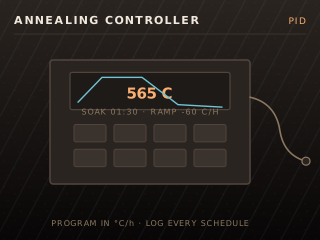
Annealing Controller
The programmer that holds the annealing point and ramps the cool.
Specifications
- Segments
- 8 – 30 ramp/hold segments on a typical unit
- Accuracy
- ± 1 – 2 °C setpoint on a good controller
- Ramp range
- Programmable from about 10 to 600 °C/h
- Thermocouple
- Type K, N or S, matched to the input
- Output
- SSR or relay, with a cycle time suited to the elements
- Alarms
- Deviation, over-temperature, thermocouple break
- Logging
- USB or network logging on newer units
Technical parameters
- PID tuning
- Autotune with a typical load inside the kiln
- SSR vs relay
- SSR is silent and gives tighter control
- Ramp units
- Program in °C/h, not °C/min, to avoid a decimal error
- Hold
- Soak time is the part beginners shorten, and should not
- Data
- Logged schedules are how you diagnose a crack after the fact
- Cost band
- Low to medium
Overview
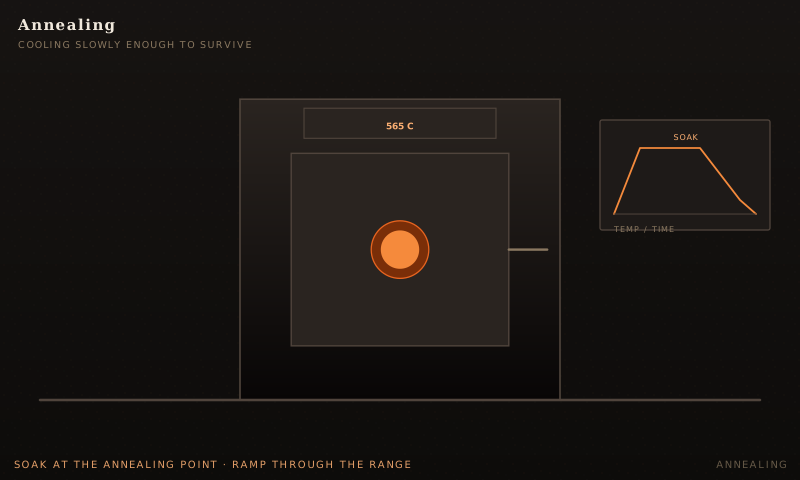
The annealing controller is the part of the kiln that decides whether the schedule is actually followed. It holds a setpoint, ramps between setpoints at a programmed rate, and soaks for a set time. The two numbers that matter most are the soak temperature — the annealing point of the glass — and the cooling rate through the annealing range, because that is where stress is introduced or relaxed.
Where it fits in the process
Annealing Controller is used in anneal. The stage decides how hot the glass has to be when the tool touches it, which in turn decides how much of the work it can do in one pass.
Safe use
- An over-temperature alarm must cut power, not just beep. A stuck SSR drives the kiln past its limit.
- Never defeat a thermocouple-break alarm. With no reading the controller may drive the elements at full power.
- Keep the controller electronics out of the kiln shell so they do not cook.
- Check the setpoint against an independent pyrometer periodically. Silent drift is the usual failure mode.
How it is used
- Program the whole schedule, including the final cool, before loading anything.
- Enter the ramp rate in °C per hour and check it twice. A decimal error of ten is a cracked piece.
- Soak at the annealing point, not at the strain point. The annealing point is the one that relaxes stress.
- Log every schedule. When a piece cracks, the log is the only evidence you have.
- Use the alarm relay to interrupt power, and test it once a year.
Compatible glass types
Matching the tool to the glass family matters less than matching the glass to itself — see the COE compatibility calculator before combining two glasses.