ANNEALING & FINISHING
Annealing Kiln
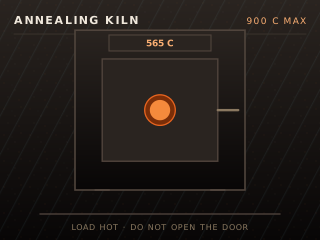
The insulated chamber that cools a piece slowly enough to survive.

Specifications
- Chamber volume
- 0.05 – 0.5 m³ for a bench studio
- Maximum temperature
- 900 – 1100 °C for a glass kiln
- Annealing range
- Around 510 °C for soda-lime, 565 °C for borosilicate
- Uniformity
- ± 5 – 10 °C is the working target
- Elements
- Kanthal or nichrome wire, often in the walls and floor
- Insulation
- Insulating firebrick with a fibre blanket
- Controller
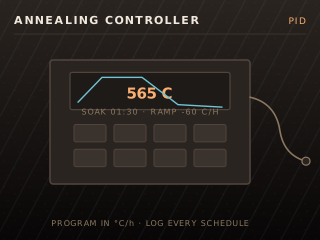
- Multi-segment ramp-and-hold, with an over-temperature alarm
Technical parameters
- Heating
- Wire elements in grooves, or a suspended coil in larger kilns
- Thermocouple
- Type K or N, placed at the work rather than at the element
- Door
- A lift or sliding door with a small peep port
- Shelf
- A kiln shelf on props, so the work is not on the floor
- Vent
- A small vent stops reducing conditions and keeps the glass clear
- Cost band
- Medium to high
Overview
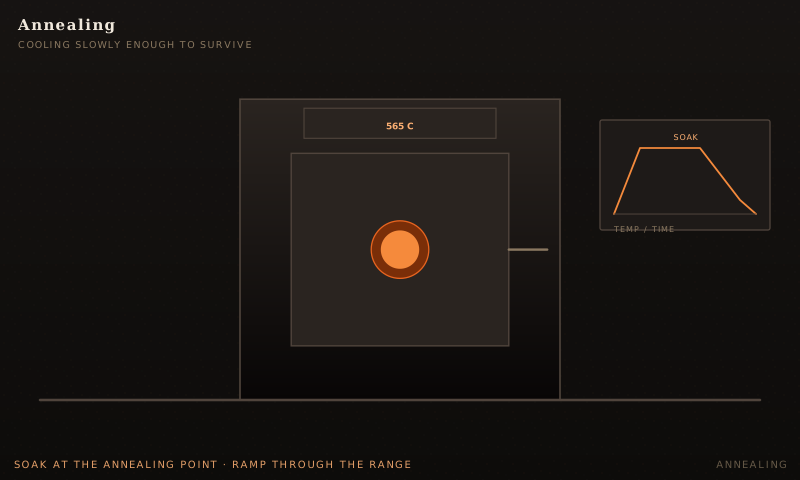
An annealing kiln is an insulated box with a controlled heat source and a programmable controller. Its job is to hold a piece at the annealing point long enough for internal stress to relax, then cool it slowly through the annealing range. Stress in glass comes from the outside cooling faster than the inside; the annealer removes that gradient slowly enough that it never becomes large enough to crack the piece. This is the step that separates a piece that lasts from a piece that looks finished and breaks on a shelf.
Where it fits in the process
Annealing Kiln is used in anneal. The stage decides how hot the glass has to be when the tool touches it, which in turn decides how much of the work it can do in one pass.
Safe use
- A kiln shell is hot for hours after the elements switch off. Post a sign and keep the area clear.
- Never open a kiln during the cooling ramp. The thermal shock will crack the work and possibly the shelf.
- Kiln elements are live even when the controller reads zero, on some units. Isolate before working inside.
- Kiln furniture is heavy and fragile. Wear gloves and eye protection when moving shelves and props.
How it is used
- Load the work hot, straight from the pipe, into a kiln already at the annealing point.
- Leave at least 25 mm between pieces and 50 mm from the elements.
- Soak at the annealing point long enough to even the whole piece — start at 1 hour per 6 mm of thickness.
- Cool through the annealing range slowly, then speed up below about 400 °C.
- Do not open the door until the chamber is below 100 °C. There is nothing in there you need to see.
Compatible glass types
Matching the tool to the glass family matters less than matching the glass to itself — see the COE compatibility calculator before combining two glasses.