ANNEALING & FINISHING
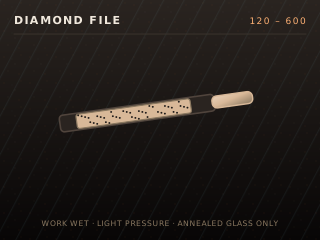
Diamond File
A diamond-abrasive file for cold-working a sharp edge or a flat.


Specifications
- Grit
- Typically 120 – 600 mesh; coarse for shaping, fine for finishing
- Length
- 150 – 300 mm
- Forms
- Flat, half-round, round and triangular
- Bond
- Electroplated, or sintered for longer life
- Use
- Wet, with water as a lubricant and coolant
- Life
- Months to years depending on grit and pressure
- Annealed glass only
- Never cold-work unannealed glass
Technical parameters
- Electroplated
- A single layer of diamond; cuts fast, wears out sooner
- Sintered
- Diamond throughout the bond; slower, lasts far longer
- Grit sequence
- Coarse to shape, fine to finish; do not skip
- Lubricant
- Water keeps the file clear and stops the glass chipping
- Pressure
- Light. Diamond cuts on speed, not on force
- Cost band
- Medium
Overview
A diamond file is a steel blank coated with diamond abrasive, used wet to cold-work annealed glass. It is the tool for taking a sharp edge off a rim, flattening a base, and shaping a piece that has already been annealed. Because diamond is harder than glass by a wide margin, it cuts steadily without dulling — but it also means a careless stroke removes material fast and cannot be undone.
Where it fits in the process
Diamond File is used in anneal. The stage decides how hot the glass has to be when the tool touches it, which in turn decides how much of the work it can do in one pass.
Safe use
- Never cold-work glass that has not been annealed. It will crack, and it may do it in your hand.
- Diamond files cut skin as readily as glass. Keep fingers behind the stroke.
- Wet-filing keeps the dust down, but the slurry is still glass waste. Contain it.
- Wear eye protection. Chips come off a rim at speed.
How it is used
- Work wet. A dry diamond file loads up, overheats and stops cutting.
- Use light pressure and let the diamond do the work. Pressure chips the edge instead of shaping it.
- Start coarse to establish the shape, then step through grades to remove the scratches.
- Rinse the work between grades so coarse grit does not contaminate the finer file.
- Finish a rim by hand, not by machine. A hand-finished rim is what people feel first.
Compatible glass types
Matching the tool to the glass family matters less than matching the glass to itself — see the COE compatibility calculator before combining two glasses.