ANNEALING & FINISHING
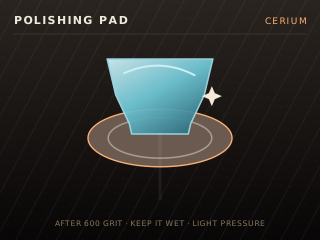
Polishing Pad
The felt or cerium pad that takes a cold surface to optical clarity.



Specifications
- Pad material
- Felt, cork, or closed-cell foam
- Polishing agent
- Cerium oxide (best for glass), tin oxide, or rouge
- Grit equivalent
- Finer than 1200 mesh; cerium is effectively sub-micron
- Speed
- Moderate — faster than grinding, but heat is the enemy
- Carrier
- Water, as a thin slurry
- Life
- Weeks to months; pads glaze and are replaced
- Surface finish
- Can reach optical clarity on a flat or a curve
Technical parameters
- Cerium oxide
- The standard for glass; cuts faster than tin or rouge
- Pad hardness
- Softer pads conform to curves; firmer pads keep a flat flat
- Speed and pressure
- Light and steady. Heat glazes the pad and clouds the glass
- Cleanliness
- A single grain of coarse grit in the pad ruins the surface
- Pairing
- Always after a 600 or finer grinding grade
- Cost band
- Low
Overview
A polishing pad is felt, cork or a synthetic foam charged with cerium oxide or tin oxide, used wet to bring a cold-worked glass surface to optical clarity. It removes the fine haze left by the last grinding grade; it does not remove scratches, and trying to polish out a scratch that a 220 grit put there will take all day and fail. Polish is the last five percent of the work and it is entirely dependent on the grades before it.
Where it fits in the process
Polishing Pad is used in anneal. The stage decides how hot the glass has to be when the tool touches it, which in turn decides how much of the work it can do in one pass.
Safe use
- Cerium oxide slurry is a mild irritant but the wheel is the hazard. Goggles, gloves and a face shield.
- A spinning pad throws slurry. Contain the tray and keep the floor dry.
- Never polish unannealed glass. It will crack, and polishing generates heat that makes it worse.
- Wash hands after handling polishing compounds. Some contain rare-earth salts.
How it is used
- Never polish before the surface is ready. If you can see a scratch, go back a grade.
- Keep the pad and the work wet. Dry polishing generates heat and clouds the glass.
- Use light pressure. Polishing is a speed process, not a force process.
- Keep a separate pad per compound. Mixing cerium and rouge gives you neither.
- Rinse the piece thoroughly and dry it with a clean cloth to check the result.
Compatible glass types
Matching the tool to the glass family matters less than matching the glass to itself — see the COE compatibility calculator before combining two glasses.