FURNACE & HEATING
Annealing Oven
The heated chamber a finished piece goes into straight off the pipe.
Specifications
- Chamber volume
- 0.1 – 2 m³ for a bench studio
- Holding temperature
- 460 – 600 °C depending on glass type
- Temperature uniformity
- ± 5 – 10 °C across the chamber
- Cooling rate
- Typically under 60 °C/h through the annealing range
- Heat source
- Electric resistance coils, or a gas burner on larger lehrs
- Insulation
- Lightweight insulating firebrick plus a fibre blanket
- Door
- A sliding or lift door with a small access port
Technical parameters
- Control
- A programmable ramp-and-hold controller is essential, not optional
- Thermocouple
- Type K or N, positioned at the work, not at the element
- Loading
- Pieces must not touch each other or the elements
- Venting
- A small vent prevents reducing conditions and soot on the work
- Soda-lime
- Soak around 510 °C
- Borosilicate
- Soak around 565 °C
- Cost band
- Medium — and worth buying with a good controller
Overview
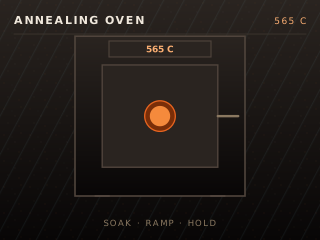
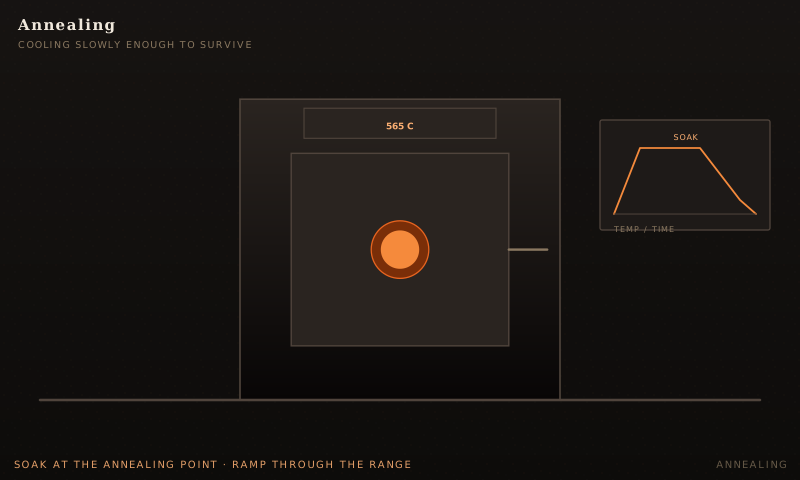
The annealing oven — often just called the annealer or the lehr — is where a piece goes the moment it comes off the pipe. It sits at the annealing point of the glass, around 510 °C for soda-lime and 565 °C for borosilicate, and its whole purpose is to let the piece cool slowly enough that internal stress can relax. A piece that is cooled too fast may look perfect and then crack hours later, or shatter on the shelf weeks after that.
Where it fits in the process
Annealing Oven is used in anneal. The stage decides how hot the glass has to be when the tool touches it, which in turn decides how much of the work it can do in one pass.
Safe use
- The door and the shell stay hot enough to burn for hours after the elements are off.
- Never open the door during the critical cooling ramp to "check" a piece. The thermal shock will crack it.
- Placing a cold object on the oven floor can shatter it. Everything that goes in must be warm.
- Carbon monoxide from a gas-fired lehr in a poorly ventilated room is a real hazard. Vent the space.
How it is used
- Put the piece in hot and let the oven do the cooling. Transferring from the pipe takes seconds and the oven must be at temperature before you start.
- Soak at the annealing point for long enough that the whole piece is even — roughly 1 hour per 6 mm of thickness as a starting point.
- Cool through the annealing range slowly, then you can speed up below about 400 °C.
- Never open the door until the chamber is below 100 °C.
- Keep a log. The schedule that worked for a 6 mm wall is not the schedule for a 20 mm sculpture.
Compatible glass types
Matching the tool to the glass family matters less than matching the glass to itself — see the COE compatibility calculator before combining two glasses.