FURNACE & HEATING
Glory Hole
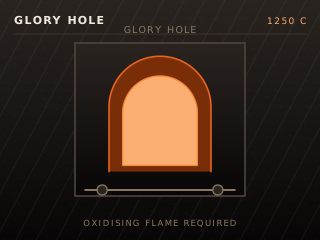
The reheating chamber that keeps a piece workable between steps.

Specifications
- Opening diameter
- 150 – 300 mm
- Operating temperature
- 1150 – 1300 °C
- Chamber depth
- 300 – 500 mm
- Heat source
- Gas burner, often with forced air; electric on small units
- Recovery time
- 10 – 40 s to bring a gather back to working temperature
- Body
- Steel shell lined with insulating firebrick and a hot-face castable
- Working height
- Set to the operator — usually 950 – 1100 mm to the sill
Technical parameters
- Burner
- Single or twin, with air/gas proportioning for an oxidising flame
- Atmosphere
- Must run oxidising or neutral; a reducing flame will grey the glass
- Door
- Sliding or hinged, to keep the chamber hot when not in use
- Rotation rest
- A pair of rollers or a yoke in front, so the pipe keeps turning
- Floor
- A flat sill that will not catch the pipe as it rolls
- Cost band
- Medium — cheaper than the furnace, used far more often
Overview
A glory hole is an open-fronted reheating chamber, hotter than the furnace and used constantly. Glass loses workability within seconds of leaving the furnace, so the rhythm of a hot shop is a loop: shape at the bench, reheat at the glory hole, shape again. The glory hole runs hotter than the furnace because its job is to bring the surface of a cooling piece back up fast, without heating the whole piece through.
Where it fits in the process
Glory Hole is used in shape, blow, color. The stage decides how hot the glass has to be when the tool touches it, which in turn decides how much of the work it can do in one pass.
Safe use
- The glory hole mouth is the brightest and hottest thing in the studio. Never look into it without appropriate eye protection.
- Radiant heat from the open mouth burns skin at a distance. A heat shield belongs on every pipe.
- A piece reheated too fast will crack. Watch the surface, not the clock.
- Keep the front sill clear. A pipe rolled into a stray tool will take the piece off the end.
How it is used
- Run the glory hole oxidising. A reducing flame deposits carbon and greys a clear glass permanently.
- Reheat little and often rather than long and rarely. Fast surface reheats keep the interior stable.
- Keep the pipe rotating whenever the piece is in the chamber. A stationary piece slumps.
- Never put a piece into the glory hole wet. Any water on the surface will spall the glass.
- Set the height once for your body and mark it. Reaching up or down all day is what wrecks a shoulder.
Compatible glass types
Matching the tool to the glass family matters less than matching the glass to itself — see the COE compatibility calculator before combining two glasses.