FURNACE & HEATING
Glass Furnace
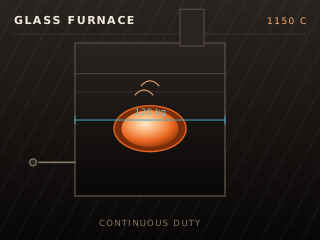
The crucible furnace that holds molten glass at working temperature, day and night.
Specifications
- Typical capacity
- 20 – 400 kg of glass (bench furnaces 40 – 120 kg)
- Holding temperature
- 1100 – 1200 °C (soda-lime); 1150 – 1250 °C (borosilicate)
- Melting a cold charge
- 8 – 24 h to first gather
- Temperature stability
- ± 5 – 15 °C at the gathering port
- Heat source
- Natural gas or propane; electric resistance on smaller units
- Refractory
- High-alumina or mullite hot face, insulating firebrick behind
- Duty cycle
- Continuous — many studios run 24 h a day for months
Technical parameters
- Fuel
- Natural gas (most common) or propane
- Consumption
- Typically 3 – 12 m³/h of gas when held at temperature
- Control
- Proportional burner control with a thermocouple on the crown
- Port design
- A gathering port sized to the pipe, with a working door
- Glass contact
- Crucible only — the flame never touches the melt directly
- Cost band
- High — the largest single capital item in a hot shop
Overview
A glass furnace is a refractory box built around a crucible of molten glass, held at 1100 – 1200 °C continuously. Unlike a kiln, it is not designed to be cycled: a working furnace is typically brought up to temperature once and held there for months, because melting a cold crucible from scratch takes a day or more and every thermal cycle costs the refractory some of its life. The furnace decides the studio: what glass you can melt, how many people can gather at once, and what your power supply has to be.
Where it fits in the process
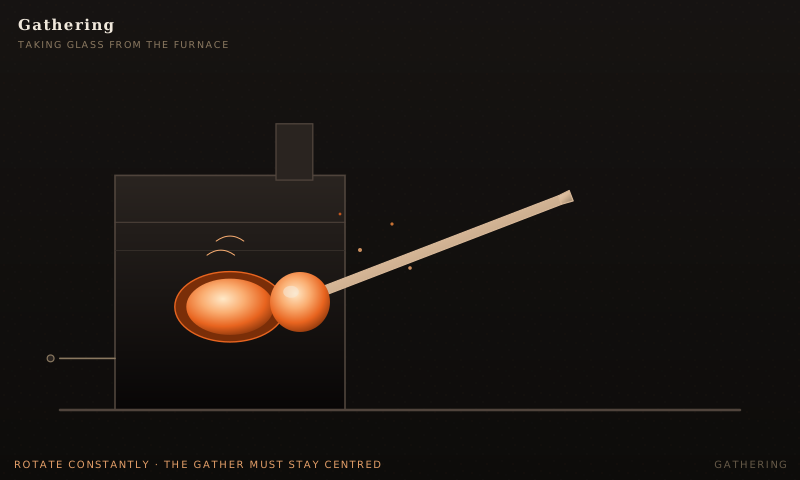
Glass Furnace is used in gather. The stage decides how hot the glass has to be when the tool touches it, which in turn decides how much of the work it can do in one pass.
Safe use
- The furnace exterior stays hot enough to burn skin on contact even when it looks inert. Treat every surface as live.
- Opening the gathering port releases a radiant wall of heat. Use a heat shield and keep your face turned away.
- Natural-gas burners must be interlocked and checked for leaks. An unlit burner feeding a hot chamber can explode on relight.
- Never leave a charged furnace unattended for long periods without a temperature alarm.
How it is used
- Hold at working temperature rather than shutting down nightly. Thermal cycling is what kills a crucible.
- Check the crown thermocouple against a hand pyrometer monthly — a drifted reading silently changes your working range.
- Skim and clean the melt surface at the start of each session; a dirty surface contaminates every gather.
- Keep the gathering port the right size for your pipe. Too large and you lose heat; too small and you cannot gather a full load.
- Never let the glass level drop below about a third of the crucible. The walls overheat and the refractory fails.
Compatible glass types
Matching the tool to the glass family matters less than matching the glass to itself — see the COE compatibility calculator before combining two glasses.