GATHERING & BLOWING
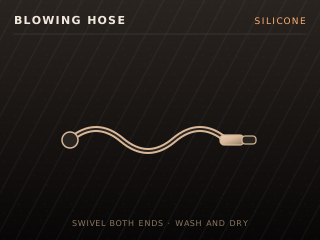
Blowing Hose
The flexible line from your mouth to the pipe's swivel.

Specifications
- Length
- 0.6 – 1.2 m
- Bore
- 6 – 10 mm
- Material
- Food-grade silicone or natural rubber; silicone tolerates heat
- Fittings
- A swivel at the pipe end, a mouthpiece at the other
- Working temperature
- Silicone to about 200 °C; rubber much less
- Weight
- Negligible
- Cleaning
- Washable; must be dry before use
Technical parameters
- Silicone vs rubber
- Silicone costs more, lasts far longer, and does not taste of rubber
- Swivel
- A ball-bearing swivel is the difference between free rotation and drag
- Mouthpiece
- A fitted tip beats putting your mouth on a bare hose
- Storage
- Coiled loosely; a kinked hose is a blocked hose
- Cost band
- Low
Overview
A blowing hose lets you inflate a piece without keeping your face against a pipe that is rotating and hot. One end fits the mouthpiece swivel, the other has a mouthpiece. The hose lets you stand back from the piece, turn your body naturally, and keep blowing while both hands are free to work the glass. It is a small accessory that changes how much control you have over a wall.
Where it fits in the process
Blowing Hose is used in blow. The stage decides how hot the glass has to be when the tool touches it, which in turn decides how much of the work it can do in one pass.
Safe use
- Never blow through a hose with a hot or wet mouthpiece. Steam and glass dust do not belong in your lungs.
- A hose that has been in contact with glass dust must be washed and dried before use.
- Do not use a hose as a handle to steady a piece. It will pull off the swivel.
- Check the hose for cracks before each session. A split hose fails at the moment of maximum pressure.
How it is used
- Keep a spare hose. They fail at the joint and they fail without warning.
- Blow with a steady, low pressure for a slow inflation you can control. Sharp bursts make lumpy walls.
- Keep the swivel clean and dry so it turns freely.
- Wash and dry the hose after every session. Glass dust and saliva are a bad combination.
- A hose lets you stand to the side of the piece, which keeps your face out of the radiant heat.
Compatible glass types
Matching the tool to the glass family matters less than matching the glass to itself — see the COE compatibility calculator before combining two glasses.
Related tools
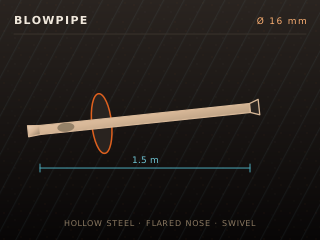
Blowpipe
The hollow steel tube you gather, shape and blow through.
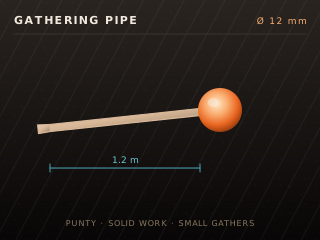
Gathering Pipe
The smaller, lighter pipe used for solid work and off-hand gathering.
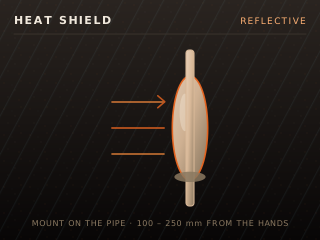
Heat Shield
The disc that stops furnace radiation reaching your hands and face.