GATHERING & BLOWING
Gathering Pipe
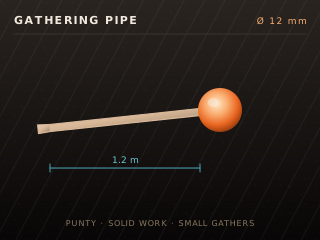
The smaller, lighter pipe used for solid work and off-hand gathering.
Specifications
- Length
- 0.9 – 1.3 m
- Outer diameter
- 8 – 14 mm
- Bore
- Solid, or 2 – 4 mm
- Material
- Mild steel or stainless
- Weight
- 0.4 – 1.0 kg
- Use
- Punty work, solid pieces, small gathers
- Nose
- Flared or plain, ground smooth
Technical parameters
- Solid vs hollow
- Solid for punty work; a small bore for blowing small forms
- Tip preparation
- A slight flare helps the punty glass grip the base
- Grip
- Often used with a wooden or cork handle for long sessions
- Pairing
- Usually one per bench, kept hot in the glory hole
- Cost band
- Low
Overview
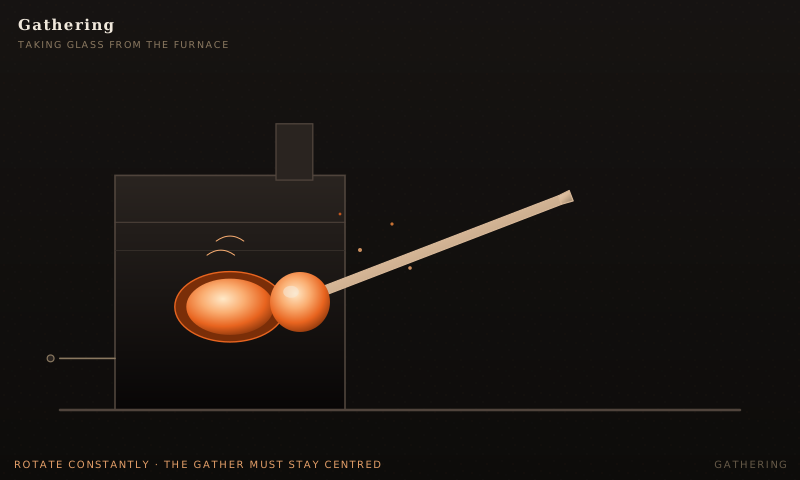
A gathering pipe — sometimes called a pontil or a punty pipe — is a shorter, thinner version of the blowpipe, usually solid or with a very small bore. It is used to take a small gather for solid work, to attach to the base of a piece as a punty so the top can be finished, and for the many small jobs in a hot shop that do not need a full blowpipe. Because it is light, it turns faster and gives finer control on small work.
Where it fits in the process
Gathering Pipe is used in gather, shape. The stage decides how hot the glass has to be when the tool touches it, which in turn decides how much of the work it can do in one pass.
Safe use
- A punty joint is a hot break waiting to happen. Never support a piece on a punty alone while you walk.
- The punty end is at glass temperature. Keep it away from clothing and from the gas line.
- A cold punty applied to a hot base will crack the piece. Warm it in the glory hole first.
- Never use a punty that has a bent nose — it will not centre and the piece will run off.
How it is used
- Warm the punty tip in the glory hole, then touch it to the centre of the base with a small blob of hot glass.
- Keep the punty joint hot while you work the top, or it will break at the worst moment.
- When you are ready to knock off, chill the joint with a wet stick or a cold file and tap the pipe.
- Keep a second punty warm in the glory hole so you are never waiting on one.
- Use a punty lighter than the piece. A heavy punty on a light piece makes every movement feel clumsy.
Compatible glass types
Matching the tool to the glass family matters less than matching the glass to itself — see the COE compatibility calculator before combining two glasses.