GATHERING & BLOWING
Heat Shield
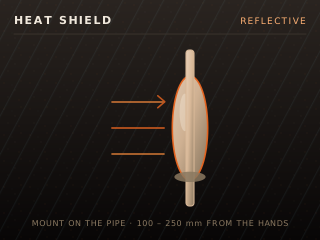
The disc that stops furnace radiation reaching your hands and face.

Specifications
- Diameter
- 120 – 250 mm
- Material
- Aluminised fabric, stainless sheet, or ceramic fibre board
- Mounting
- Sliding collar on the pipe, secured with a grub screw
- Position
- 100 – 250 mm from the hands
- Weight
- 0.15 – 0.6 kg
- Reflectivity
- Aluminised shields reflect the most, but tarnish
- Cleaning
- Wipe down; do not scrub the reflective face
Technical parameters
- Reflective vs absorbent
- Reflective shields bounce radiant heat; absorbent ones soak it and re-radiate
- Mounting
- A shield that slides is worth more than one that is welded on
- Standoff
- A small air gap behind the reflective face improves performance
- Pairing
- A shield works with, not instead of, the correct gloves
- Cost band
- Low
Overview
A heat shield is a disc of metal, ceramic or reflective fabric mounted on the blowpipe between your hands and the glass. It blocks radiant heat from the furnace mouth and the glory hole, which is the difference between working for two hours and working for twenty minutes. Radiant heat does not care about air temperature — a shield works because it is between you and the source, so placement matters more than material.
Where it fits in the process
Heat Shield is used in gather, blow, shape. The stage decides how hot the glass has to be when the tool touches it, which in turn decides how much of the work it can do in one pass.
Safe use
- A heat shield protects against radiant heat, not against contact. It will not stop you burning your hand on a pipe.
- Never rely on a shield alone. Heat exhaustion is cumulative across a session.
- Check the mounting before every gather. A loose shield will slide down the pipe into the glass.
- Reflective shields can focus light. Keep them off the face and away from anything flammable.
How it is used
- Set the shield where your hands actually sit, not where it looks tidy.
- Give it a standoff gap from the pipe so it does not conduct heat straight into the collar.
- Use it with correct gloves and a face shield. One piece of PPE does not substitute for another.
- Check the collar screw at the start of every session.
- A shield also protects the glass from your skin oils, which etch a hot surface.
Compatible glass types
Matching the tool to the glass family matters less than matching the glass to itself — see the COE compatibility calculator before combining two glasses.