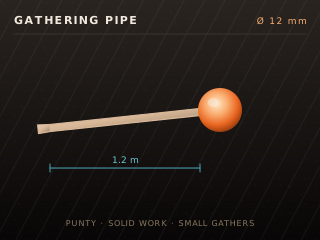
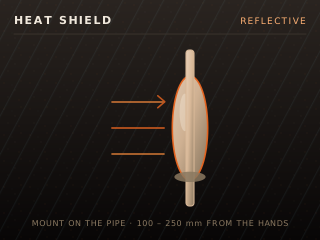
GATHERING & BLOWING
Blowpipe
The hollow steel tube you gather, shape and blow through.
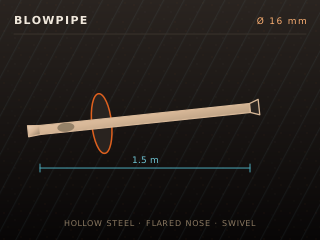
Specifications
- Length
- 1.2 – 1.6 m (standard 1.5 m)
- Outer diameter
- 12 – 25 mm; 16 mm is a common general-purpose size
- Wall thickness
- 1.5 – 2.5 mm
- Material
- Seamless mild steel or stainless; stainless resists scale
- Weight
- 0.8 – 2.2 kg empty
- Mouthpiece
- Tapered or fitted with a swivel and a rubber or silicone tip
- Nose
- Flared and ground smooth so the glass releases cleanly
Technical parameters
- Steel grade
- Mild steel is traditional; 304 or 316 stainless lasts longer
- Heat treatment
- None — the pipe anneals itself in use and that is fine
- Nose preparation
- Ground and polished; a rough nose grips the glass and tears it
- Swivel
- A rotating coupling lets you turn the pipe without turning your body
- Balancing
- Pipes are often counter-weighted for long sessions
- Cost band
- Low to medium
Overview
The blowpipe is the tool the craft is named after: a hollow steel tube, usually 1.2 – 1.5 m long, with a mouthpiece at one end and a slightly flared nose at the other. Glass is gathered on the nose, and the whole piece is worked while it rotates on the pipe. Pipe diameter matters more than most beginners expect — a wider pipe holds a heavier piece more stably but is harder to turn, and a narrow pipe is easier on the wrists but limits how large a piece you can carry.
Where it fits in the process
Blowpipe is used in gather, blow, shape. The stage decides how hot the glass has to be when the tool touches it, which in turn decides how much of the work it can do in one pass.
Safe use
- The nose of the pipe is at glass temperature and stays hot long after the glass is off. The pipe is not a handle.
- Never blow into a pipe whose nose is still in the furnace — the pressure can flash back.
- A hot pipe laid across a bench starts fires. Use a rack, never the bench top.
- Check for a cracked mouthpiece before use. A burr will cut a lip and a split will not seal.
How it is used
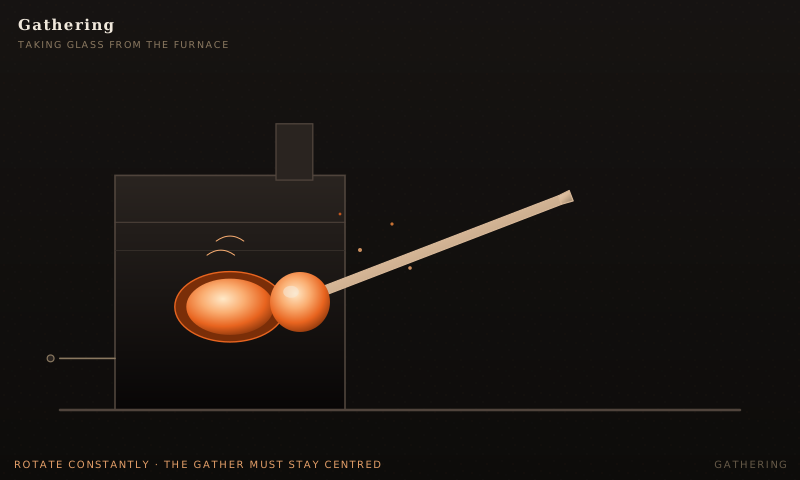
- Keep the pipe turning from the moment it leaves the furnace. A stationary pipe lets the gather droop off-centre.
- Warm a new pipe gently the first time; a cold pipe in molten glass will chill the gather and can shock the nose.
- Keep the nose clean and polished. A build-up of scale on the nose shows up as a ring in every piece.
- Match the pipe to the piece. A 25 mm pipe for a 200 g bubble is a fight you do not need to have.
- Store pipes horizontally on a rack. A pipe leaned in a corner bends.
Compatible glass types
Matching the tool to the glass family matters less than matching the glass to itself — see the COE compatibility calculator before combining two glasses.