SHAPING & TOOLS
Diamond Shears
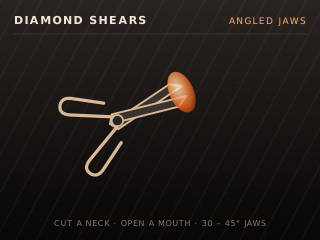
Angled shears that cut a neck or open a mouth without crushing.
Specifications
- Length
- 250 – 380 mm
- Jaw angle
- Jaws set at roughly 30 – 45° to the handles
- Material
- High-carbon steel
- Blade length
- 60 – 110 mm
- Opening
- Up to about 60 mm at the jaw tips
- Weight
- 0.4 – 0.8 kg
- Edge
- Straight, single bevel
Technical parameters
- Angled jaws
- The angle lets you reach a neck the straight shears cannot
- Rotation
- Cut while the pipe turns for an even mouth
- Heat
- Same as straight shears — hot glass only
- Pairing
- Used with the straight shears, not instead of them
- Cost band
- Medium
Overview
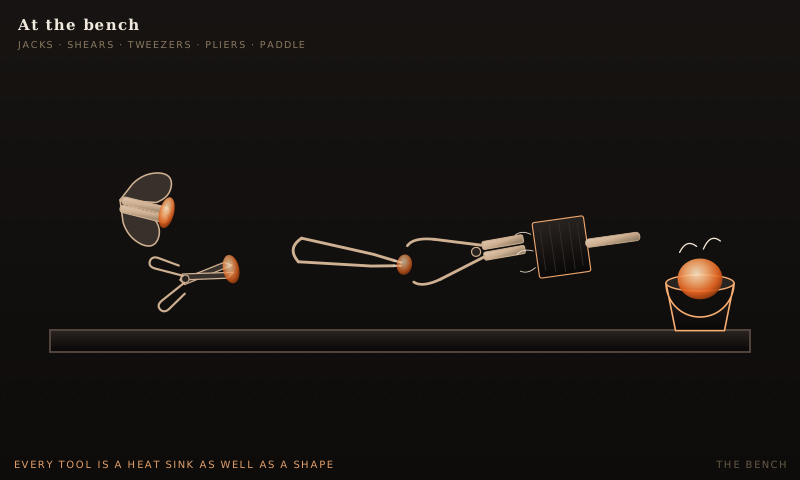
Diamond shears have angled jaws that close from the outside of a piece inward, which lets you cut a neck or open a mouth without crushing the form. The name refers to the shape of the cut they leave — a clean bevelled notch. They are the tool for separating a piece from its punty cleanly, opening a vessel mouth to an even diameter, and cutting a neck down before a transfer.
Where it fits in the process
Diamond Shears is used in shape, blow. The stage decides how hot the glass has to be when the tool touches it, which in turn decides how much of the work it can do in one pass.
Safe use
- Angled jaws are easy to catch on a rotating pipe. Keep your hand clear of the rotation.
- A diamond-shear cut on cool glass shatters. Reheat rather than force it.
- Hot shears burn through a glove in seconds. Put them in a rack.
- Never cut toward yourself. The jaws throw the offcut outward.
How it is used
- Rotate the pipe steadily and close the jaws slowly into the turning glass for an even cut.
- Use them to open a mouth to diameter: cut, reheat, cut again, rather than one deep cut.
- Warm the jaws before cutting a thick neck.
- Cut the neck almost through, then chill and tap — this gives the cleanest break.
- Re-flame the cut edge so the mark disappears.
Compatible glass types
Matching the tool to the glass family matters less than matching the glass to itself — see the COE compatibility calculator before combining two glasses.