SHAPING & TOOLS
Shears
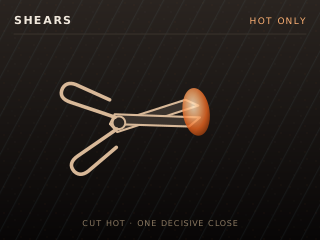
The straight shears that cut hot glass cleanly.
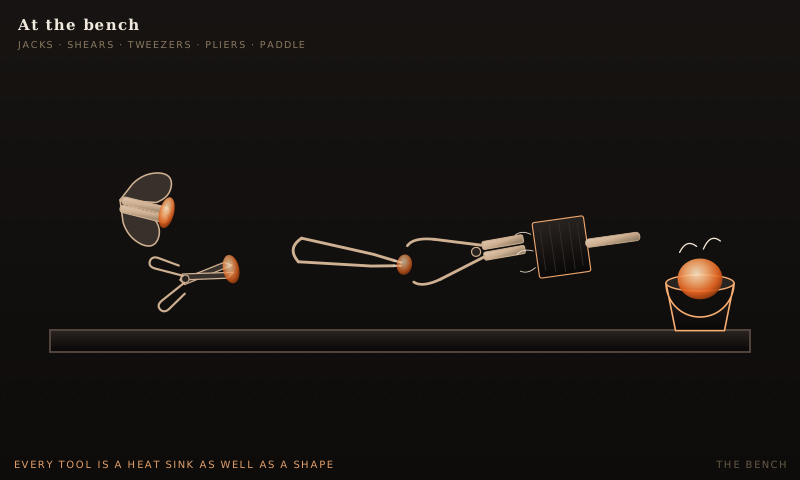

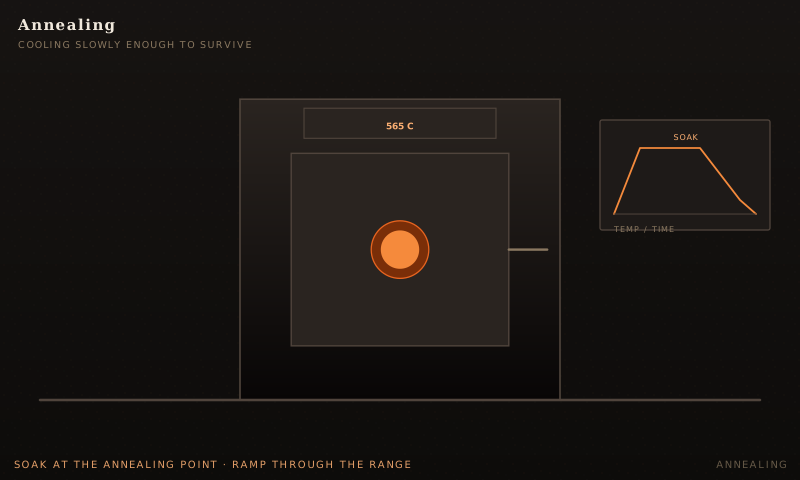
Specifications
- Length
- 250 – 400 mm
- Blade length
- 70 – 130 mm
- Material
- High-carbon or stainless steel
- Edge
- Single or double bevel; a slight curve helps
- Handle
- Long, often with a spring return
- Weight
- 0.4 – 0.9 kg
- Cut capacity
- Glass up to about 25 mm thick when hot
Technical parameters
- Bevel
- A single-bevel blade cuts straighter but is harder to sharpen
- Spring
- A return spring saves a hand over a session
- Heat
- Warm the blades before a heavy cut to avoid a chill crack
- Sharpening
- Cold, on a fine stone; never sharpen hot
- Cost band
- Low to medium
Overview
Hot-glass shears look like heavy scissors and cut molten glass the way scissors cut paper — but only if the glass is hot enough. Shears are used to trim the lip of an opening, cut a gather off a pipe, snip a trail of decoration, and open a mouth. A cut made on hot glass leaves a clean edge that flame-polishes itself; the same cut on cooler glass leaves a crack that will propagate.
Where it fits in the process
Shears is used in shape. The stage decides how hot the glass has to be when the tool touches it, which in turn decides how much of the work it can do in one pass.
Safe use
- Hot shears burn. They belong in a rack, not on the bench top and not in a hand you are not watching.
- Cutting cold or cool glass with shears shatters it. If it does not cut easily, it is too cold — reheat it.
- Snips of hot glass fly. Wear eye protection and keep your face back from the cut.
- Never cut toward your body or toward another person. The offcut travels further than you expect.
How it is used
- Cut hot, decisively, once. Two half-hearted cuts leave a ragged edge.
- Warm the blades in the glory hole before a heavy cut on a thick piece.
- Cut a lip by rotating the pipe steadily and closing the blades slowly into the turning glass.
- Re-flame the cut edge so the shears mark disappears.
- Keep the blades dry and lightly oiled between sessions. Rust pits the edge.
Compatible glass types
Matching the tool to the glass family matters less than matching the glass to itself — see the COE compatibility calculator before combining two glasses.