SHAPING & TOOLS
Tweezers
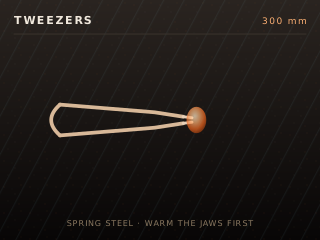
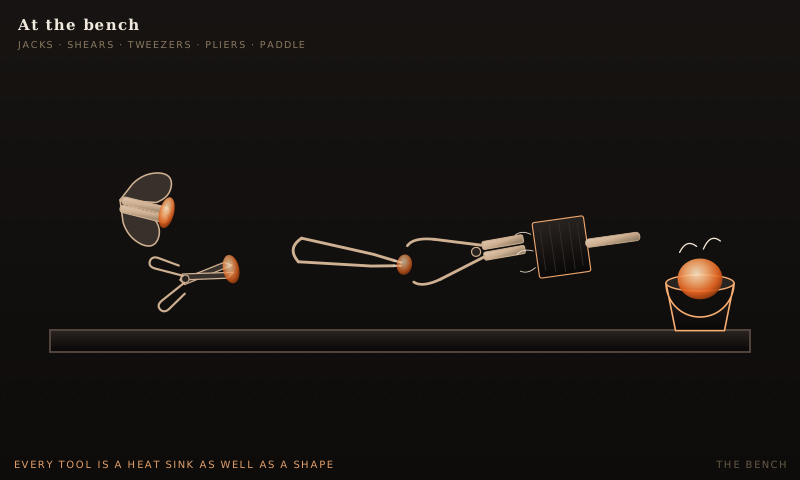
Long spring steel pincers for pulling, pinching and opening a lip.
Specifications
- Length
- 200 – 400 mm
- Material
- Spring steel or stainless
- Jaw shape
- Flat, serrated or round depending on the job
- Jaw width
- 4 – 15 mm
- Spring
- Integral, or a bow spring between the arms
- Tip finish
- Ground smooth; serrations grip but mark the glass
- Weight
- 0.1 – 0.3 kg
Technical parameters
- Flat jaws
- General pulling and pinching; least marking
- Serrated jaws
- Grip a wet or smooth surface; leave marks you must polish out
- Round jaws
- Opening a lip and shaping an inside curve
- Heat
- Warm the jaws slightly before use to reduce chill marks
- Cost band
- Low
Overview
Glassblowing tweezers are long, spring-steel pincers — much longer than a jeweller’s tweezers, because they have to reach hot glass while your hand stays a safe distance away. They are used for detail work: pulling a lip outward, pinching a neck, drawing a thin thread of glass out of a gather, or picking a bubble out of the surface. Because they are steel, they chill whatever they touch, which is why they are used on hot glass and in short contacts.
Where it fits in the process
Tweezers is used in shape. The stage decides how hot the glass has to be when the tool touches it, which in turn decides how much of the work it can do in one pass.
Safe use
- Tweezers are hot seconds after touching glass. Put them down on a rack, never on the bench or in a pocket.
- The jaws are sharp. Do not use them to move a piece you cannot see properly.
- Long tools magnify hand tremor at the tip. Brace your forearm on the bench rail.
- Never cool tweezers in water between uses on the same piece — the chill mark will crack it.
How it is used
- Work on hot glass. Tweezers on glass below working temperature will crack it rather than move it.
- Warm the jaws in the glory hole for a second before a delicate pull.
- Use the lightest contact that does the job. Steel pulls heat out fast and leaves chill marks.
- Keep a flat-jawed and a round-jawed pair at the bench. They do different jobs.
- Re-flame-polish the area you tweaked so the marks disappear.
Compatible glass types
Matching the tool to the glass family matters less than matching the glass to itself — see the COE compatibility calculator before combining two glasses.