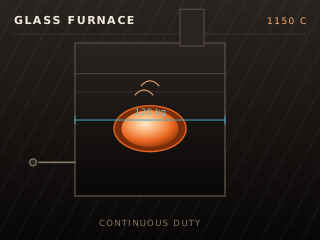
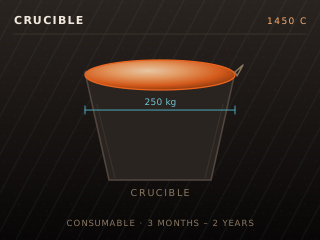
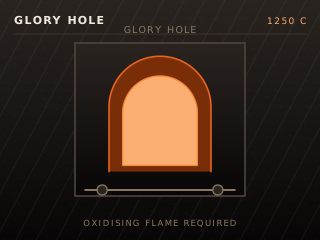
FURNACE & HEATING
Exhaust Hood
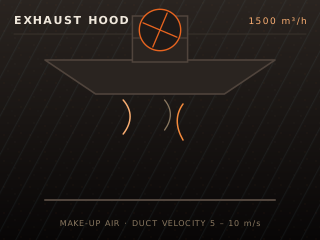
Extraction over the furnace mouth, the glory hole and the bench.

Specifications
- Flow rate
- Canopy over a furnace: typically 1500 – 4000 m³/h
- Canopy height
- 600 – 1200 mm above the source
- Capture velocity
- At least 0.25 – 0.5 m/s at the source face
- Duct velocity
- 5 – 10 m/s to keep particulates entrained
- Material
- Galvanised or stainless steel; aluminium is not suitable for hot service
- Make-up air
- Must be provided — at least 80 – 90 % of the extracted volume
- Filtration
- Coarse for fumes; HEPA and carbon where odour or metals matter
Technical parameters
- Canopy type
- Low-profile canopy close to the source beats a distant hood
- Duct route
- As short and straight as possible; every bend costs flow
- Fan
- In-line centrifugal, sized for the duct run and not just the canopy
- Filtration
- Particulate first, then carbon, so the carbon is not blinded
- Make-up
- A tempered supply, or a louvre placed away from the hood
- Cost band
- Medium — and cheaper than the alternative
Overview
A hot shop produces three things you should not breathe: combustion products from the burners, metal fumes and oxides vaporised off the glass, and fine dust from cold-working and from handling raw batch materials. An exhaust hood over the heat sources removes the first two, and a separate bench extraction handles the third. Make-up air matters as much as extraction — a hood that pulls 2000 m³/h out of a sealed room creates a pressure problem, not a ventilation system.
Where it fits in the process
Exhaust Hood is used in gather, shape, color, anneal. The stage decides how hot the glass has to be when the tool touches it, which in turn decides how much of the work it can do in one pass.
Safe use
- Ventilation protects against carbon monoxide, metal fumes and silica dust. Do not work hot glass in a closed garage.
- A hood that cannot keep up with a burner is worse than none, because it gives false confidence.
- Never block a make-up air path to stop a draught. The burner needs the air more than you need the comfort.
- Clean the duct. Grease and soot accumulate, and a duct fire in a hot shop has nowhere good to go.
How it is used
- Put the canopy close to the source. Capture falls off with the square of distance.
- Provide make-up air deliberately. An unplanned gap under a door is not a design.
- Run the extraction for several minutes after the burners are off — combustion products linger.
- Check the flow with a smoke pencil at least twice a year.
- Separate the cold-working extraction from the hot-shop extraction. They capture different things.
Compatible glass types
Matching the tool to the glass family matters less than matching the glass to itself — see the COE compatibility calculator before combining two glasses.