COLOR & SURFACE
Grinding Medium
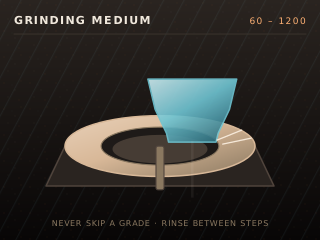
Silicon carbide grit and the carrier that feeds a grinding wheel.



Specifications
- Abrasives
- Silicon carbide (most common), aluminium oxide, diamond
- Grit grades
- 60, 120, 220, 400, 600, 1200 mesh and finer
- Carrier
- Water, or oil for a finer finish on a metal-bonded wheel
- Feed rate
- A thin slurry, not a flood
- Silicon carbide
- Sharp and fast; breaks down quickly
- Diamond
- Longest life and most expensive; used on hard cold-working
- Cost band
- Low
Technical parameters
- Grit sequence
- Never skip more than one grade; the work goes up exponentially
- Wheel material
- Cast iron for coarse, felt or cork for polishing
- Speed
- Slower for coarse grit, faster for polishing
- Slurry
- A thin suspension; too thick and it glazes instead of cutting
- Cleanliness
- Rinse the work between grades or coarse grit contaminates the fine
- Cost band
- Low, but the sequence is time-expensive
Overview
Grinding medium is the abrasive — usually silicon carbide or aluminium oxide grit — suspended in water or oil and fed onto a grinding wheel. It is what actually removes glass in cold-working; the wheel only carries it. Grit is graded by mesh number, and the sequence from coarse to fine is the same principle as sanding wood: you cannot skip a grade without spending longer on the next one than you saved.
Where it fits in the process
Grinding Medium is used in anneal. The stage decides how hot the glass has to be when the tool touches it, which in turn decides how much of the work it can do in one pass.
Safe use
- Silicon carbide slurry is a skin and eye irritant. Goggles and gloves, and a face shield on a spinning wheel.
- Wet grinding keeps the dust down but the slurry is still a silica-bearing waste. Do not pour it down a drain.
- A wheel throwing slurry is a slipping hazard. Keep the floor dry and the tray contained.
- Never grind dry with a coarse grit. The airborne dust is a serious lung hazard.
How it is used
- Work the grades in order. Skipping from 120 to 600 leaves scratches that no amount of time at 600 will remove.
- Rinse the piece thoroughly between grades so coarse grit does not contaminate the finer wheel.
- Keep the slurry thin. A thick slurry glazes the surface instead of cutting it.
- Use water as the carrier for coarse work and oil for the final stages on metal wheels.
- Flatten a base on the coarsest grit first, then work up. A base that is not flat will not become flat later.
Compatible glass types
Matching the tool to the glass family matters less than matching the glass to itself — see the COE compatibility calculator before combining two glasses.