SHAPING & TOOLS
Jacks
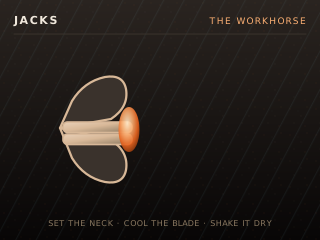
The curved-blade tool that sets a neck and opens a form.
Specifications
- Length
- 300 – 450 mm
- Blade length
- 80 – 150 mm
- Blade curve
- Matched pair, radius matched to the neck size
- Material
- Mild or stainless steel blades, hardwood or alloy handle
- Weight
- 0.5 – 1.1 kg
- Handle
- One wooden arm and one steel arm on a traditional pair
- Cooling
- Dipped in water between passes
Technical parameters
- Blade radius
- A matched radius makes an even neck; mismatched blades wobble
- Cooling
- Water cooling stops the blade transferring heat up the arm
- Blade shape
- Straight, curved and square-nosed sets cover different forms
- Adjustment
- The gap is set by the handle, and changes as the tool wears
- Cost band
- Medium — but a good pair outlives everything else in the shop
Overview
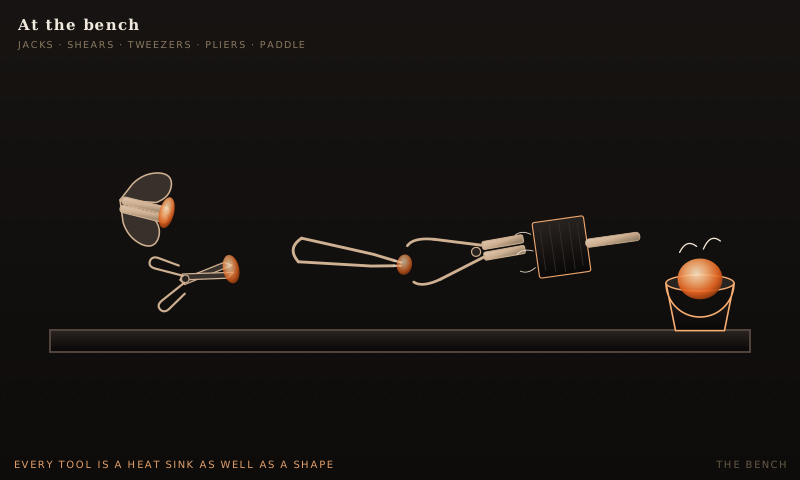
Jacks are the most-used hand tool in a hot shop. They are a pair of curved blades, usually with a wooden handle on one arm and a metal blade on the other, that grip the neck of a piece and squeeze it down as the pipe turns. That action both sets a neck and pushes glass outward, which is how a bubble becomes a vessel. A good pair of jacks is a lifetime tool; the blades are cooled in water and re-shaped as they wear.
Where it fits in the process
Jacks is used in shape, blow. The stage decides how hot the glass has to be when the tool touches it, which in turn decides how much of the work it can do in one pass.
Safe use
- Jacks are hot at the blade end and cool at the handle — until they are not. Check before gripping.
- Never cool a blade in water and immediately apply it to hot glass. The wet blade shock-cracks the neck.
- Keep fingers behind the blade. The closing action has real force.
- A blade with a burr will tear the neck. Inspect and dress it.
How it is used
- Keep the pipe turning and close the blades slowly. Jacks cut a neck; they do not clamp it.
- Cool the blade in water between passes, but shake the water off before it touches glass.
- Work from the neck outward. Setting the neck first gives you something to pull against.
- Use a light touch on thin walls. Jacks can crush a bubble faster than you can react.
- Re-flame the neck after jacking so the chill marks close and the piece evens out.
Compatible glass types
Matching the tool to the glass family matters less than matching the glass to itself — see the COE compatibility calculator before combining two glasses.