FURNACE & HEATING
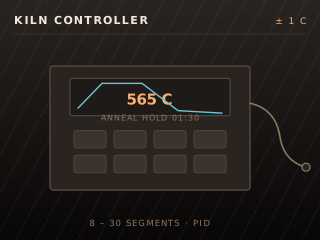
Kiln Controller
The ramp-and-hold programmer that runs an annealing or fusing schedule.


Specifications
- Program segments
- Typically 8 – 30 ramp/hold segments
- Setpoint accuracy
- ± 1 – 2 °C on a good unit
- Ramp rates
- Programmable from about 10 to 600 °C/h
- Thermocouple
- Type K, N or S; matched to the controller
- Output
- Relay, SSR or analogue 4 – 20 mA
- Alarms
- Deviation, over-temperature and thermocouple-break
- Interface
- Front-panel keys; USB or Ethernet on newer units
Technical parameters
- PID control
- Proportional-integral-derivative, tuned to the kiln mass
- Autotune
- Most units will characterise the kiln themselves
- SSR output
- Silent and fast-cycling; preferred over mechanical relays
- Data logging
- Worth having — a schedule you cannot see is a schedule you cannot improve
- Cold-junction
- Compensated internally; a bad junction shifts every reading
- Cost band
- Low to medium — the cheapest way to improve a kiln
Overview
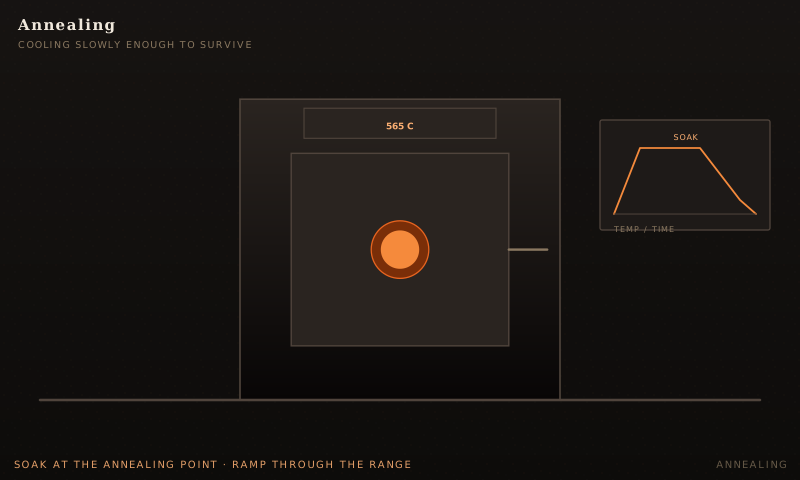
A kiln controller is the difference between annealing and hoping. It holds a setpoint, ramps between setpoints at a controlled rate, and soaks for a set time. Manual control by eye was normal decades ago and is the reason so much old glass is full of stress. A modern controller with a proper thermocouple position will hold an annealing schedule reliably enough that the kiln becomes the least interesting part of the process, which is exactly what you want.
Where it fits in the process
Kiln Controller is used in anneal. The stage decides how hot the glass has to be when the tool touches it, which in turn decides how much of the work it can do in one pass.
Safe use
- An over-temperature alarm is not optional. A stuck relay can take a kiln past the point where the elements fail.
- Do not defeat a thermocouple-break alarm. The controller will drive the elements to full power with no reading.
- Keep the controller out of the kiln shell so its own electronics do not cook.
- Check the setpoint against an independent pyrometer occasionally. Silent drift is the usual failure.
How it is used
- Enter the whole schedule, including the final cool to room temperature, before you load anything.
- Autotune once with the kiln at working temperature and a typical load inside.
- Verify the thermocouple position with the work, not against the element. A reading taken next to a glowing coil is fiction.
- Use the alarm relay to cut power, not just to beep.
- Write the schedule down. Six months later you will not remember which program did which piece.
Compatible glass types
Matching the tool to the glass family matters less than matching the glass to itself — see the COE compatibility calculator before combining two glasses.