GATHERING & BLOWING
Newspaper Pad
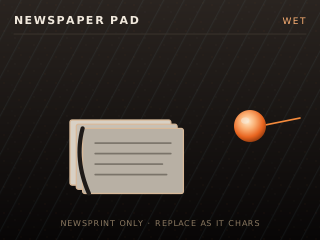
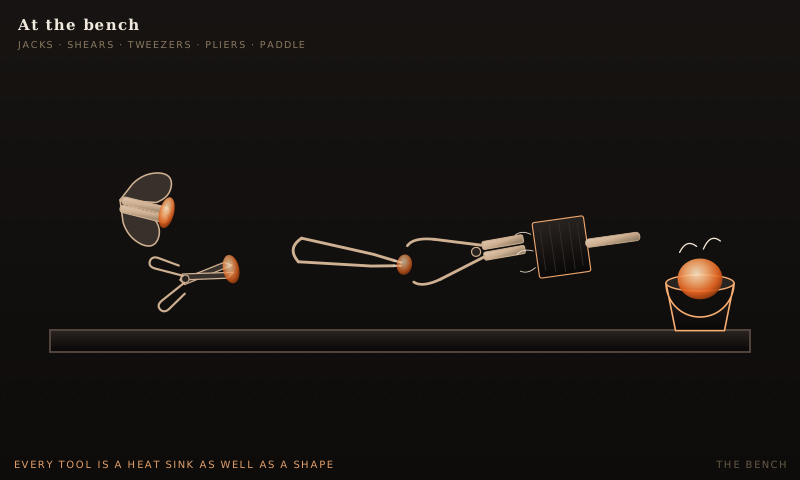
Wet newspaper, used to shape and polish the hot glass by hand.

Specifications
- Material
- Newsprint — not glossy magazine paper
- Size
- A folded pad roughly 120 × 200 mm
- Layers
- 6 – 20 sheets, folded to a comfortable grip
- Soak
- Fully saturated, wrung so it does not drip
- Life
- Minutes to one session — it chars and is discarded
- Grip
- Heavy leather gloves; a bare hand will be scalded
- Shape
- Re-folded constantly as it burns
Technical parameters
- Paper choice
- Newsprint has the right density and no clay coating
- Wetness
- Dripping wet is correct; dry paper will ignite
- Use
- Smoothing, flaring, cooling and finishing — one tool, four jobs
- Discard
- Charred black paper marks the glass and should be replaced
- Cost band
- Negligible
Overview
A pad of wet newspaper is the cheapest and most versatile shaping tool in a hot shop. Folded wet, it is used to smooth a gather, flare a lip, cool a surface and put the final sheen on a piece before it goes into the annealer. Like the wooden block it relies on a steam cushion, but because it is soft it conforms to the glass and reaches shapes a rigid block cannot. It burns away as you use it, which is the point.
Where it fits in the process
Newspaper Pad is used in shape, blow. The stage decides how hot the glass has to be when the tool touches it, which in turn decides how much of the work it can do in one pass.
Safe use
- Wet newspaper still burns. Keep a dry spare away from the furnace and never let a pad dry out while holding it.
- The steam is scalding. Heavy leather gloves and a face shield are required, not optional.
- Ink from newsprint can mark a hot surface. Use clean pages, not the sports section.
- Never use glossy or coated paper. The coating fumes and can contaminate the glass.
How it is used
- Fold the pad thick and soak it through. A thin pad transmits heat straight to your hand.
- Keep the pipe turning and the pad moving. Holding it still flattens the piece.
- Use a fresh fold as each one chars. Black paper smears carbon onto the glass.
- A light touch with a wet pad gives a fire-polished sheen that saves cold-working later.
- Keep a bucket of water at the bench so you can re-wet the pad without walking away.
Compatible glass types
Matching the tool to the glass family matters less than matching the glass to itself — see the COE compatibility calculator before combining two glasses.