GATHERING & BLOWING
Wooden Block
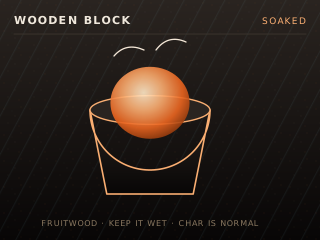
The soaked fruitwood block that shapes and cools a gather.

Specifications
- Material
- Pear, apple or beech — close-grained hardwoods
- Diameter
- 60 – 140 mm
- Cup depth
- 30 – 60 mm
- Handle
- Usually none; held in a soaked cloth or a leather mitt
- Soak time
- At least 30 minutes, ideally overnight
- Life
- Weeks to months depending on use; the cup burns away
- Shape
- A range of cup sizes is normal for one bench
Technical parameters
- Wood choice
- Close grain holds water and resists splitting; open grain chars too fast
- Water
- Fresh, clean water. Dirty water marks the glass surface
- Temperature
- A block shapes hot glass; it cannot shape glass below working temperature
- Rotation
- The pipe must keep turning or the block will flat-spot the gather
- Cost band
- Low
Overview
A wooden block is a hollowed fruitwood or hardwood cup, soaked in water, used to shape a gather into a symmetrical sphere and to chill its surface. It works by two mechanisms at once: the curved surface forces the glass round as the pipe turns, and the water in the wood flashes to steam against the hot glass, creating a cushion of vapour that stops the block sticking. Charring the surface is normal and expected.
Where it fits in the process
Wooden Block is used in shape, blow. The stage decides how hot the glass has to be when the tool touches it, which in turn decides how much of the work it can do in one pass.
Safe use
- Steam from a block is scalding. Keep your face out of the plume and your hands out of the vapour path.
- Never use a dry block. A dry block sticks to the glass and tears the surface off.
- The block gets hot as it works. Hold it in a soaked cloth, not bare-handed, for long shaping.
- A split block can pinch. Retire it rather than gluing it.
How it is used
- Soak the block thoroughly. A damp block is a working block; a wet one is better.
- Turn the pipe continuously and keep the block moving slightly so the gather does not flat-spot.
- Use the block early, while the glass is hot enough to move. It is a shaping tool, not a finishing tool.
- Re-soak the block between uses. It dries out fast next to a furnace.
- Keep two or three cup sizes. A block that is too big will not reach the neck; too small and it will not centre the bubble.
Compatible glass types
Matching the tool to the glass family matters less than matching the glass to itself — see the COE compatibility calculator before combining two glasses.